

Pueblo-Style Homes and Ductless Heating and Cooling
Thick walls and flat roofs suit ductless systems, as long as the line set and condensate never give water a way in.
- NM CID License #413436
- 24 Google reviews
- Led by Dominic Montoya, over 20 years in the trade
- Free written estimates
By Dominic Montoya, Owner of Red Wrench Company. Published , updated .
A mini split in an adobe home in Albuquerque is often the cleanest way to add heating and cooling, because no ductwork has to pass through walls or viga ceilings. The hard part is the small refrigerant line. On a thick wall and a flat roof, its route decides whether the job stays dry for decades.
Why Do Pueblo-Style Homes Fight Ductwork?
These houses have little room to hide a duct. Flat roofs leave no attic, and exposed vigas and plaster ceilings leave little to work with. Many real adobes were never built with a chase, and furring a duct through a room changes its character.
Start by finding out what you actually own. A Pueblo Revival look can be frame or block under stucco, and that is a very different job from earthen walls. Knock on the wall, check window depth and look at old plans. The location of the walls that carry the roof matters as well.
For true earthen construction, New Mexico's Earthen Building Materials Code (14.7.4 NMAC) shows the scale involved. It allows 14-inch adobe walls on the lower story of a two-story building and 10 inches above, and it requires at least 18 inches for exterior rammed earth walls. Older walls are often thicker.
Thick Walls Change the Penetration, Not the Idea
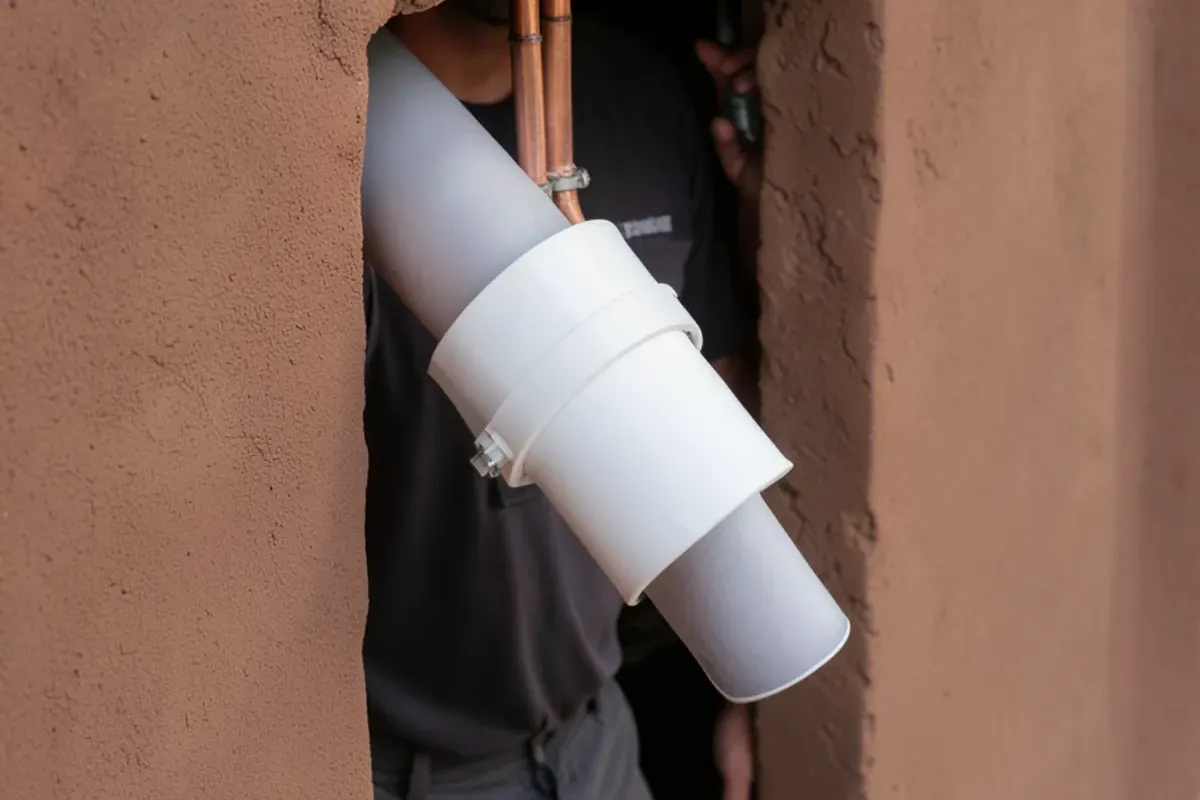
ENERGY STAR says a mini split needs only a three-inch hole in an outdoor wall. That is true for a typical frame wall. Through two feet of adobe, it is a long core that has to be drilled carefully, sleeved and sealed.
Use a sleeve with a slight fall to the outside, so any water trapped inside drains away from the wall. Do not patch around it with portland cement. The National Park Service's Preservation Brief 5 warns that cement mortars are incompatible with unstabilized adobe, because the materials expand and contract at different rates, and that cement patches can trap moisture in the wall. Match the patch to the existing surface coating.
Where the wall has been plastered in mud, lime or cement stucco, tell the installer before work begins. A contractor who has not asked is guessing. On a historic building, get preservation advice first.
How Should a Line Set Cross a Parapet?
The short answer is that it should avoid breaking the waterproof top of the parapet at all costs.
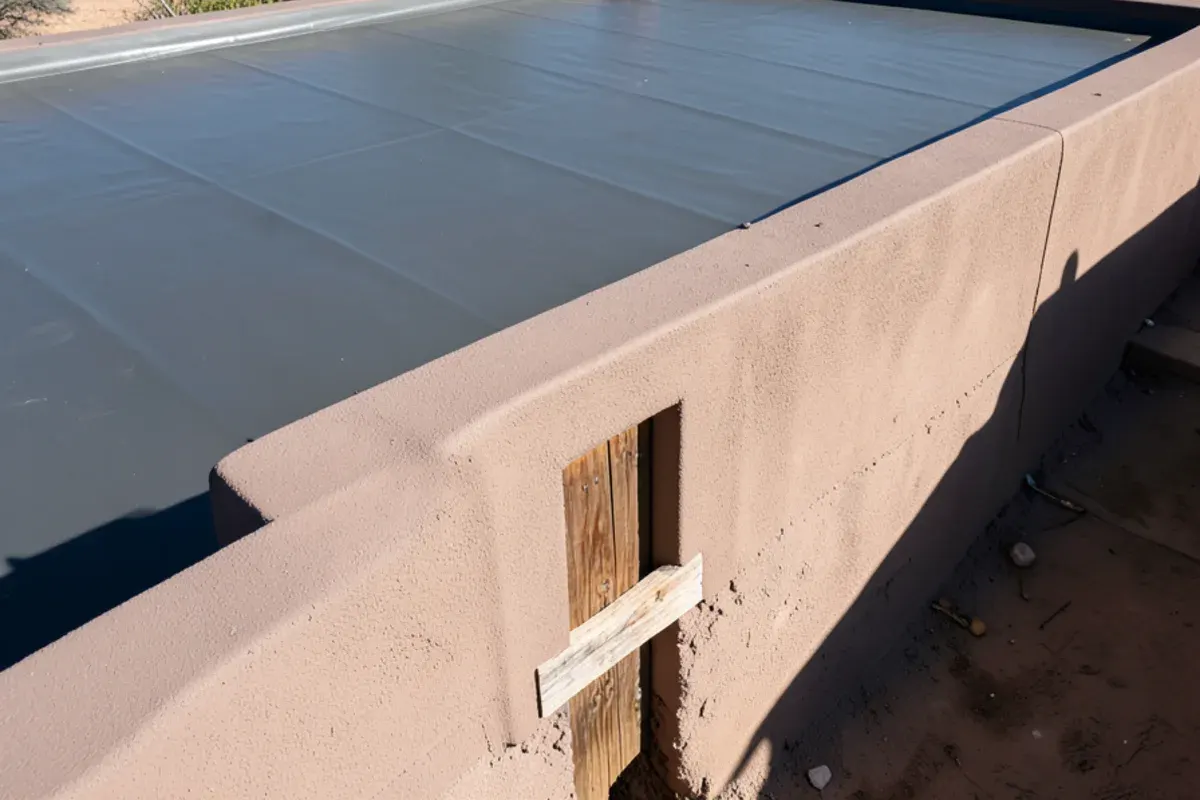
Parapets are the most exposed part of a flat-roofed house. Preservation Brief 5 identifies rain erosion on roofs and parapets as a main source of adobe deterioration, and says survival depends on how well a structure sheds water. The state earthen code calls for an unbroken, impermeable waterproof cover on plastered adobe parapets. Any cut through that cap is a new leak path.
Here is how we compare the usual routes.
| Route | Works well when | Watch for |
|---|---|---|
| Through the wall behind the head, down to a ground unit | The outdoor unit can sit near the wall | Line cover must be neat, and the core must fall to the outside |
| Interior closet or chase to a ground unit | Head is on an inside wall | Longer runs may need added refrigerant |
| Through the roof at a flashed curb or boot, to a roof unit | No good ground location exists | Roofer must flash into the membrane, never tape it |
| Reuse of an old swamp cooler opening | A cooler curb is being retired | Curb, flashing and roof must be sound |
| Over the parapet in a cover | Rarely the first choice | Must not pierce or crush the cap, and adds weathering exposure |
Longer runs have limits. Each model's manual sets maximum length and height, and PNNL's Building America guide notes refrigerant may need to be added when the line runs longer than the factory charge allows.
Roof Units, Canales and Condensate
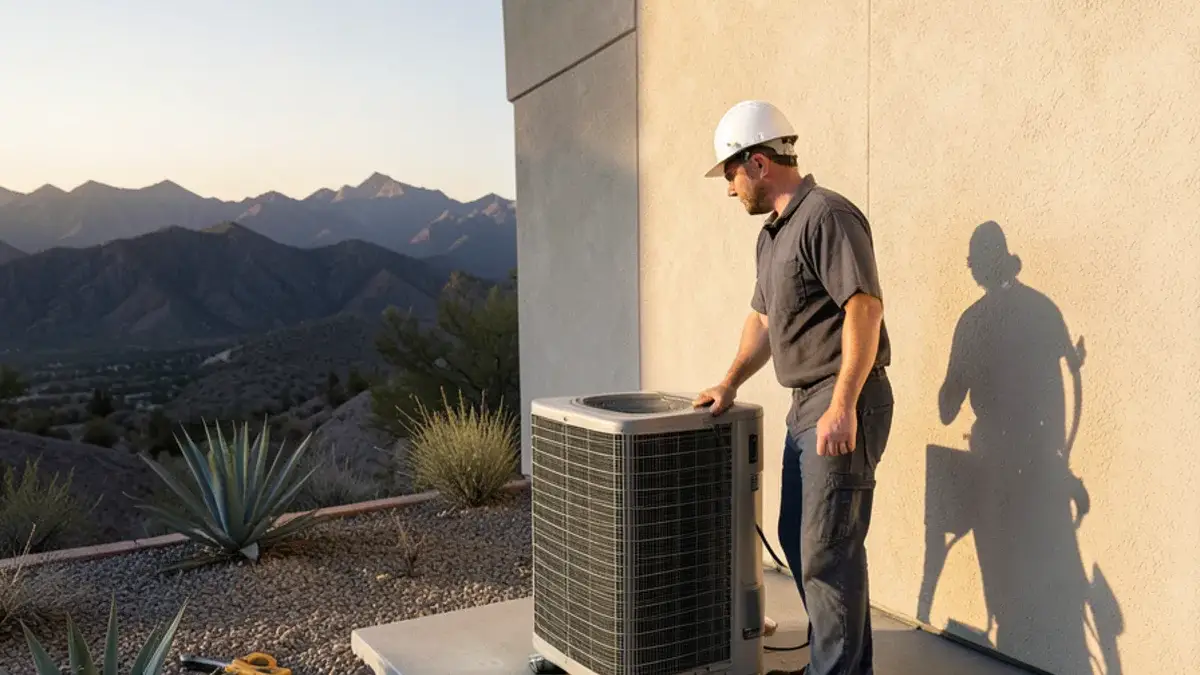
Set a condenser on the ground when you can. If it must go on the roof, use a proper stand or curb that the roofer details, and keep it out of the paths water takes to the canales. Hiding it tight behind a parapet can trap discharge air, so check the manufacturer's clearances.
Condensate is the quiet risk in this type of home. Heads pull water from the air all summer. Preservation Brief 5 says leaking pipes and condensation can do more damage to an adobe than to a brick, stone or frame structure. Run the drain so it empties well away from the wall base. Never let it dribble down plaster or pool at the foundation.
PNNL's guide also advises against placing an outdoor unit where roof runoff, melting snow or ice can fall on it, which rules out many spots under canales.
Sizing a Mini Split for an Adobe Home in Albuquerque
Mass slows heat, but it does not cancel it. Thick earthen walls take hours to warm and hours to cool, which evens out daily swings. They do not behave like a modern insulated wall in every condition, and a long cold spell or a west wall in August can still load the room.
That is why a mini split should be sized from a Manual J calculation using the real wall assembly. PNNL warns that oversized or badly placed heads can short cycle, which hurts efficiency and comfort. Lower head locations help heating performance. Do not mount a head above an exterior door.
Thick-walled rooms are also separated rooms. An open plan may run off one head, but a bedroom behind a two-foot wall will not share air with the hallway. Plan on zones. Our ductless mini split work starts with that room-by-room layout, and a heat pump head can replace an aging wall heater where the numbers work.
What We Tell Customers With Flat Roofs
- Decide the line route first. Head location comes second, so that the route never forces a cut in a parapet.
- Bring the roofer in early for any roof penetration or curb.
- Do not cement over a core. Match what the wall is made of.
- Inspect at the first monsoon. Check every penetration and drain after the first big storm.
- Permit it. Replacement and new mechanical work generally calls for a permit, so confirm with your building authority. Every quote should state who pulls the permit, and ours does.
Homes in Corrales, where adobe-style construction is common and ducts are hard to run, are a natural fit for this approach.
What Ductless Gives Up in an Adobe House
Ductless solves the duct problem and creates a few smaller ones. Weigh these before you sign.
- Visible equipment. You keep the ceiling intact, and you add a white head to a plaster wall and a line cover outside. In a room with fine vigas and deep windows, some owners count that as a real cost.
- Single-zone or multi-zone. One outdoor unit per head means more pads and more wall cores, and one failure stays in one room. A multi-zone outdoor unit cuts pads but lengthens the line runs, and its failure takes every head down with it.
- More filters to clean. PNNL's guide puts mesh filter cleaning at about every two weeks, and deep cleaning of wall heads at every 1 to 3 years, usually a professional job. A ducted system has one filter to change.
- Keep the old heater or remove it. Leaving a wall heater gives you backup on the coldest nights, while removal frees the wall and simplifies the room. Review the manufacturer's low-temperature capacity data before you give up any heat source.
Plan the line set, the condensate and any roof work before anyone picks a head location.
Bringing It Together
A Pueblo-style house and a ductless system get along well when water stays out of the conversation. Respect the wall, leave the parapet alone, drain the condensate well away, and size from the real assembly. Do that and you gain room-by-room comfort without opening a single viga ceiling.

Areas we serve
Common questions
Can a mini split be mounted on an adobe wall?
Yes. Heads mount on a plate fastened to the wall, and on adobe or earthen plaster the fasteners must suit the material. Soft plaster will not hold a standard anchor well. The installer should locate solid material first and use anchors meant for it. Tell them what the wall is made of, and check for embedded wiring before drilling.
Should a condenser go on a flat roof or on the ground?
Ground mounting is usually the better choice. It avoids new roof penetrations, makes service easier and keeps weight off older roof structures. A roof mount makes sense when no ground location works or when neighbors and setbacks rule it out. In that case have the roofer detail the stand and flashing, and confirm that the roof can carry the load.
Will a mini split heat an adobe home through a Corrales winter?
Often yes, if it is chosen for cold weather. NOAA engineering data puts Albuquerque's 99 percent design temperature at 19°F, and Corrales can run colder on valley nights. Output falls as the air gets colder, so ask for the manufacturer's capacity at your design temperature instead of the headline rating. Thick walls help by holding heat, though they take a long time to recover after a setback.
Sources
- National Park Service, Preservation Brief 5: Preservation of Historic Adobe Buildings
- 14.7.4 NMAC, New Mexico Earthen Building Materials Code
- ENERGY STAR, Certified Mini Split Heat Pumps fact sheet (2025)
- PNNL Building America Solution Center, Ductless Mini-Split Heat Pumps
- New Mexico RLD, Apply for a Permit
- NOAA NCEI, Engineering Weather Data: Albuquerque
Rather have someone look at it?
Call any hour. You get a straight answer, a free written estimate and the price before the work starts.
- NM CID License #413436
- 24 Google reviews
- Led by Dominic Montoya, over 20 years in the trade
- Free written estimates
Red Wrench Company, 5635 Paradise Blvd NW, Albuquerque, NM 87114, (209) 563-1270